

Stereo vs Stems for Mastering
Stereo Mastering Is Usually the First Choice
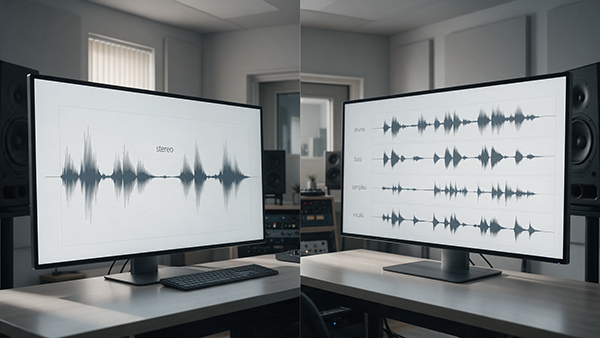
Most mastering projects arrive as a stereo mix, and that’s generally the preferred format. When the balance between the instruments is right, a stereo file provides everything needed to finish the record.
Before going further, it’s important to distinguish stems from full track-outs. Stems are grouped elements of a mix, such as drums, bass, samples, and vocals, exported as separate audio files. Full track-outs are the individual channels from the original mixing session, including separate kick, snare, hi-hat, bass, and every single insrtrument and vocal exported to their own tracks. Stem mastering involves working with a handful of exported busses, rather than reconstructing the entire mix from individual channels.
The Principle: Use Stems to Solve Specific Problems
A mastering engineer can accomplish quite a bit with a stereo file. Broad tonal adjustments, dynamic control, stereo imaging, and loudness can all be handled without access to individual elements. But every adjustment to a stereo mix affects everything occupying the frequencies being processed. Even with the sometimes magical mid-side eq and compression techniques. That’s where stems can become useful.
Suppose the bass is overpowering the kick drum. Reducing the low frequencies in a stereo master may tame the bass, but it can also reduce the smack of the kick. With separate drum and bass stems, the bass can be addressed directly while leaving the kick alone. If the mixing engineer simply doesn’t know how to carve room for both of those instruments, a common problem in hoip hop production, that additional control may produce a better result, particularly when the mix itself is otherwise working well.
Use stems when a specific problem requires control over individual elements of the mix. The benefit should be apparent when comparing the finished master against the original stereo mix. If there’s no mix improvement, the stereo version may be the better choice.
When Stem Mastering Actually Helps
In hip hop, the relationship between drums, bass, and samples is especially important. A sampled loop may contain substantial low-frequency information, sometimes competing with the kick and bass. That overlap can gum up everything when compression and limiting are applied during mastering. Having the sample on a separate stem allows its low-frequency content to be adjusted without weakening the drums. Often when the mixing engineer is also the producer, they can’t bring themselves to use high pass filters on instruments they’ve been listening to for months (or even years).
Drum impact is another situation where stems can help. If the drums are sitting slightly behind a dense sample, raising their level or adjusting their dynamics can improve the record considerably. Attempting the same thing with stereo EQ or compression affects other instruments as well. With a drum stem, a smaller, more specific adjustment can be made while leaving the rest of the mix intact.
Vocals are another common reason to consider stem mastering. A vocal might sit comfortably in the original mix but become less intelligible when the master reaches its intended loudness. Having separate vocal and instrumental stems provides control over that relationship. Sometimes a fraction of a decibel is enough to bring the vocal forward without changing the character of the instrumental.
There are limits to what makes sense here. If the snare needs a different reverb, the kick is fundamentally wrong, or the vocal requires extensive automation, those are mixing issues. If the mixing session is available, revising the mix is often the most direct solution. Stem mastering is useful when the mix is strong and only a few sounds need adjusting.
Tools and Inputs: Preparing Stems Correctly
Properly prepared stems are essential. Every stem should begin at exactly the same point and extend through the complete song, including any reverb or delay tails. They should also share the same sample rate, bit depth, and export settings. This allows the mastering engineer to import the files, align them at the same starting position, and reproduce the intended mix.
It’s also important to consider processing on the original mix bus. If the stereo mix uses bus compression, saturation, or limiting, exporting individual stems through that processing can produce unexpected results. A compressor responding to the entire mix behaves differently when only the drum stem passes through it. The mastering engineer needs to know what processing was used and how the stems were created. Almost all of the time: if you’re doing stem mastering, cut the compressors on all busses. Let it be done in mastering.
The original stereo mix should always accompany the stems. It provides a reference for the intended balance, dynamics, and overall sound. Ideally, the stems should reconstruct that balance closely when played together at their original levels. If the summed stems sound substantially different, that discrepancy needs to be understood before mastering begins.
The Stem-Mastering Process
The process begins by listening to the original stereo mix and identifying anything that needs attention. Mastering can reveal problems that were less obvious during mixing, especially when increasing the overall level. Important areas include the bass, the relationship between the kick and sample, vocal placement, and how the entire mix responds to dynamic processing. From there, it’s possible to determine whether the available stems offer any advantage.
Once the stems are imported, the first step is to reproduce the original mix as closely as possible. The combined stems should be compared with the stereo reference at matched listening levels. Any differences need to be accounted for before making adjustments. Otherwise, it’s difficult to know whether an improvement came from the mastering work or from an unintended change during the export process.
Next, attention can turn to the specific elements that prompted the decision to use stems. If the sample is masking the bass, EQ can reduce the competing frequencies. If the drums need more presence, a small level adjustment or some carefully chosen dynamic processing may be sufficient. If the vocal needs attention, its stem can be processed while preserving the instrumental balance.
Common Mistakes in Stem Mastering
One mistake is processing each stem simply because separate control is available. It’s tempting to add EQ, compression, or saturation to every group, especially when working with an extensive mastering chain. But each adjustment changes the relationship between the instruments. The most reliable approach is to make the fewest changes necessary and evaluate their effect on the complete mix.
Another mistake is delivering stems that don’t reproduce the original stereo mix. Missing effects, inconsistent export levels, or incorrectly handled bus processing can all create differences. Even a small change in the balance can affect the way the combined signal responds to mastering compression and limiting. Checking the summed stems against the stereo reference before delivery can prevent a lot of unnecessary work.
Final Checklist: Stereo or Stems?
When deciding between stereo and stem mastering, start with the finished mix. Listen for specific problems that ordinary mastering processing may struggle to address. Pay particular attention to drum and bass balance, competing low frequencies in sampled material, and the relationship between the vocals and instrumental. Consider whether a simple mix revision would resolve those issues more effectively.
If the mix is already balanced, send the stereo file. If a few grouped elements need independent attention, stems can provide worthwhile control. Make sure the stems are properly aligned, preserve the intended processing, and reproduce the original mix as closely as possible.
The decision should come down to what the music needs. Some records benefit substantially from the additional control of stem mastering. Others sound exactly as they should with conventional stereo mastering, and that’s how they should be left.
All Categories
About Dume41

Dume has been producing, recording, and mixing hip hop records since 1996, and mastering them since 2005. He is the founder of the record label Fresh Chopped Beats, where he has worked on music featuring artists such as Abstract Rude, Afu-Ra, Gabriel Teodros, Geologic/Prometheus Brown, Jeru The Damaja, Khingz, King Khazm, Macklemore, Percee P, Sean Price, Sir Mix-A-Lot, Sizzla, Specs Wizard, Vitamin D, and many, many others. His mastering chain is built around a high-end analog hardware setup designed to add depth, warmth, and polish while keeping the artist’s intent intact. To work with Dume on music contact him here.